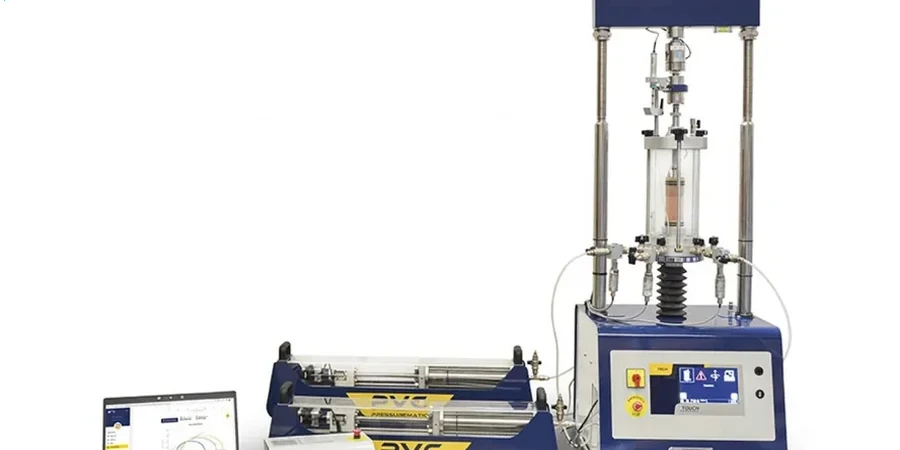
In Sunderland, the geological complexity beneath the surface often surprises even experienced contractors. The city sits on a mix of Permian magnesian limestone overlain by glacial till, with pockets of softer alluvial deposits along the River Wear corridor. When we receive cores from sites near the river or from the higher terraces towards Tunstall Hill, the first question is always about shear strength under the specific stress conditions the soil will actually experience in service. A standard unconfined test simply does not capture the behaviour of these materials once you go deeper than a few metres. That is why the triaxial test becomes essential for any critical foundation or earthworks design in Sunderland. It allows us to replicate the in-situ confining pressures and drainage conditions, whether the soil is a stiff clay from the till or a weathered zone within the limestone sequence, giving the design team reliable parameters for effective stress analysis.
Accurate effective stress parameters from a well-executed triaxial programme prevent both over-design and unsafe assumptions in Sunderland's varied ground conditions.
Regional considerations
Sunderland's development pattern followed the heavy industries that once lined the Wear, from shipbuilding to coal mining. The city's expansion onto former industrial land means many current projects encounter made ground of variable composition, often containing slag, ash, or demolition rubble. When a triaxial test is omitted from the ground investigation scope on these sites, the designer is left assuming shear strength values from generic correlations that cannot account for the fill's unique fabric and compressibility. The consequences range from excessive settlement of shallow footings to actual slope failures in temporary excavations. On a recent warehouse project near the former docks, the CU triaxial results revealed an effective friction angle 4 degrees lower than the conservative estimate from SPT N-value correlations — a difference that would have compromised the bearing capacity calculation entirely. In Sunderland's post-industrial context, the triaxial test is not an academic exercise; it is a practical safeguard against the uncertainties inherent in disturbed ground.
Quick answers
How many triaxial specimens do you need for a site in Sunderland?
For a site-specific ground investigation in Sunderland, we typically recommend a minimum of three specimens per distinct soil layer to define a reliable Mohr-Coulomb failure envelope. In practice, this means we often receive 6 to 9 undisturbed samples from a single borehole through the glacial till sequence. The exact number depends on the stratigraphic complexity and the project's geotechnical risk category.
What is the cost of a triaxial test programme?
A triaxial testing programme for a Sunderland site generally ranges from £1.300 to £2.380, depending on the number of specimens, the test type (CU, CD, or multi-stage), and the required confining pressures. We provide a detailed quotation once we review the borehole logs and the design requirements.
How long does it take to get triaxial test results?
Standard reporting time is 10 to 14 working days from sample receipt, though this can extend for CD tests due to the slow strain rate required. We can often accommodate a faster turnaround for CU tests if the project schedule demands it — please discuss this with the laboratory when dispatching the samples.
Do you perform triaxial tests on weathered rock from the Sunderland limestone?
Yes, we regularly test weak rock cores from the Permian magnesian limestone found across Sunderland. These are typically run as CD triaxial tests on NQ or HQ diameter specimens, paying particular attention to the influence of discontinuities and weathering grade on the measured strength parameters.