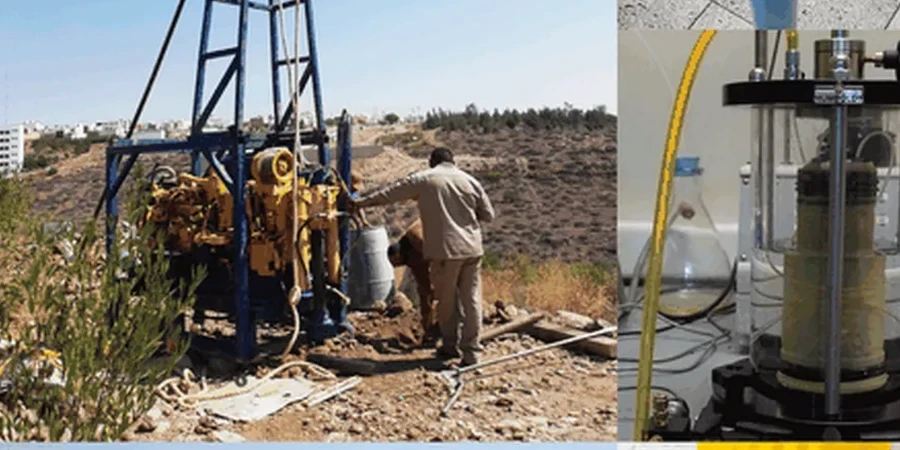
Sunderland’s development from a trio of medieval settlements into a major port and industrial centre left a complex geological footprint across the city. The expansion onto the magnesian limestone plateau above the Wear, combined with Victorian terracing on the river terraces, means foundation conditions can shift dramatically within a single postcode. Our laboratory sees samples every week from the boulder clay that underlies much of Ashbrooke and the softer alluvial silts closer to the river. A proper [soil mechanics study]() in this city has to reconcile the stiff glacial tills of the inland wards with the compressible estuarine deposits near the Port of Sunderland. Without that local understanding, even a conservative foundation design can end up mismatched to the ground it sits on. We run classification and strength testing under BS 5930 so the numbers that reach the design desk reflect what the ground actually does, not what a generic textbook predicts.
In our experience, the biggest risk in Sunderland is not the till or the limestone, but the transition zones where both meet and drainage concentrates.
Process and scope
Sunderland sits at roughly 80 metres above sea level on the limestone uplands but drops to near sea level along the Wear corridor, and that 80-metre gradient concentrates drainage in ways that directly affect soil behaviour. The city’s population of around 275,000 occupies everything from nineteenth-century terraces on shallow fill to modern steel-frame warehouses on the former shipyard land at Pallion. In our [soil mechanics study]() programme, we regularly see effective stress parameters and consolidation characteristics that vary more across a two-kilometre transect than they would across an entire county elsewhere. Triaxial testing often reveals that the weathered zone of the Roker Dolomite can lose significant strength when saturated; at the same time, the overlying Devensian till tends to stand up well in excavation but needs careful assessment of its drained shear strength for long-term slope stability. We also run routine particle size analysis and Atterberg limits on the laminated clays that appear in pockets near the river, because their plasticity can mislead a quick visual classification.
Regional considerations
The contrast between Sunderland’s coastal exposure and its sheltered river valleys creates specific geotechnical challenges. East of the A19, salt-laden winds and marine aerosols accelerate weathering of exposed limestone and can alter the chemistry of near-surface soils over decades—something we account for when testing sulphate content and pH for concrete design. Meanwhile, the Wear floodplain combines high groundwater with soft alluvial clays that are prone to both settlement and, in certain gradings, to internal erosion if drainage isn’t carefully controlled. A [soil mechanics study]() that only looks at strength and ignores chemical aggressivity or long-term consolidation behaviour misses half the picture. We’ve seen projects where the bearing capacity was adequate but the predicted settlement under working loads exceeded the serviceability limit, simply because the oedometer testing had been skipped in the initial scope.
Quick answers
What does a soil mechanics study typically cost for a residential project in Sunderland?
For a typical Sunderland residential scheme requiring a programme of classification, shear strength, and consolidation tests on samples from two or three boreholes, the laboratory component usually falls between £2,520 and £4,320, depending on the number of triaxial and oedometer stages specified.
How do you handle the weathered limestone that appears on many Sunderland sites?
Weathered magnesian limestone, common across the city’s higher ground, is treated with particular care in the laboratory. We assess the degree of decomposition and run strength tests at natural moisture content to capture the in-situ behaviour; if the material is friable, we also look at its breakdown under compaction because that can affect the performance of granular fill placed directly on the rockhead.
What’s the typical turnaround for laboratory testing on a Sunderland ground investigation?
Routine classification and compaction testing is usually reported within seven to ten working days from sample receipt. Consolidated triaxial and oedometer tests take longer because of the saturation and consolidation stages, but we aim to deliver the full interpretative report within three to four weeks, aligning with the programme most local consulting engineers expect.