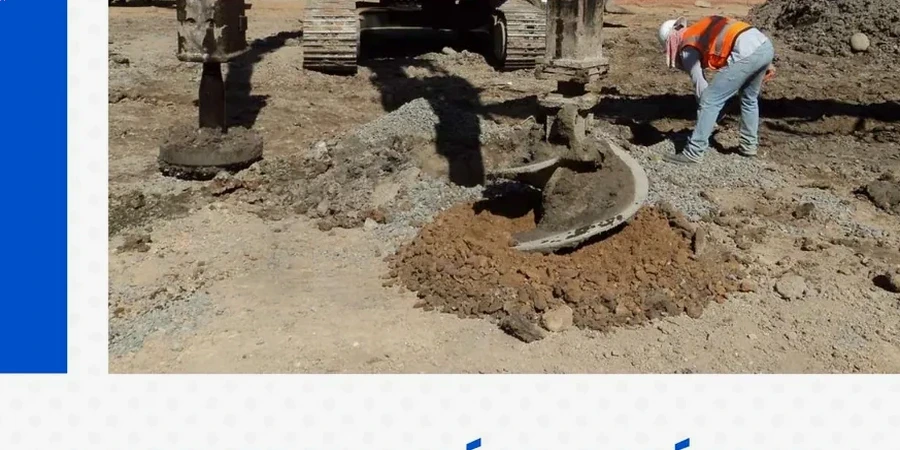
Sunderland's industrial legacy left more than shipyards. The alluvial clays and uncompacted fill along the River Wear create some of the most compressible building ground in the North East. Designing stone columns here means confronting buried demolition rubble, tidal groundwater fluctuations, and the weathered Coal Measures mudstone that underlies much of the city center. Standard vibro-replacement assumptions fail fast when the driller hits a forgotten culvert or a lens of laminated clay. We approach each stone column design by first mapping the fill thickness with a dense grid of CPT testing to isolate zones where the clay sensitivity ratio exceeds 4. That data drives the column diameter, spacing, and the load-transfer platform specification. In the Hendon area, where the made ground exceeds 5 m, we adjust the installation sequence to prevent lateral displacement toward the riverfront quay walls.
A stone column design without CPT profiling in Sunderland's fill is just a guess. The column stiffness ratio relies on knowing what the vibroflot actually displaces.
Process and scope
Eurocode 7 (BS EN 1997-1:2004) mandates serviceability checks that control our stone column design process. For Sunderland, Design Approach 1 Combination 2 usually governs the bearing capacity limit state on the improved ground. We reference BS 5930 for the site investigation phase, particularly Clause 34 on in-situ tests in soft ground. The column stiffness ratio depends on the constrained modulus of the surrounding Sunderland clay, which we derive from oedometer tests on undisturbed Shelby tube samples. A critical parameter here is the area replacement ratio: in the Southwick basin, where silty clay thickness reaches 8 m, we model a triangular grid at 1.8 m spacing to achieve a settlement reduction factor above 2.5. The load-transfer platform design follows the Hewlett and Randolph method, adapted for angular limestone aggregate sourced from the nearby Durham quarries.
Quick answers
How do you design stone columns in Sunderland's made ground where obstructions are present?
We rely on a pre-construction CPT grid to map obstruction zones. Where tip resistance spikes above 15 MPa, we recommend pre-drilling or a stone column design with smaller diameter at closer spacing to bypass the obstruction while maintaining the area replacement ratio.
What aggregate specification is suitable for stone columns in acidic Sunderland mine water areas?
Standard limestone aggregate can degrade under pH values below 5.5, common in former coal mining zones. We specify dolomitic aggregate with a Los Angeles abrasion value below 30 and limit the acid-soluble sulfate content to protect column integrity over the design life.
How is the settlement reduction factor calculated for Sunderland alluvial clays?
The settlement reduction factor is the ratio of untreated settlement to treated settlement. We calculate it using the Priebe method, inputting the constrained modulus of the Sunderland clay from oedometer tests and the area replacement ratio from the column grid geometry.
What is the typical cost range for stone column design in Sunderland?
The design phase for stone column ground improvement in Sunderland typically falls between £1.060 and £4.300, depending on the treated area, the number of CPT profiles required, and the complexity of the load-transfer platform analysis.
Which limit states control the design of stone columns under Eurocode 7 in the UK?
For Sunderland conditions, the ultimate limit state is governed by bearing capacity (STR/GEO) under Design Approach 1 Combination 2. The serviceability limit state controls through settlement and differential settlement checks, which are critical in the variable fill thicknesses found across the city.