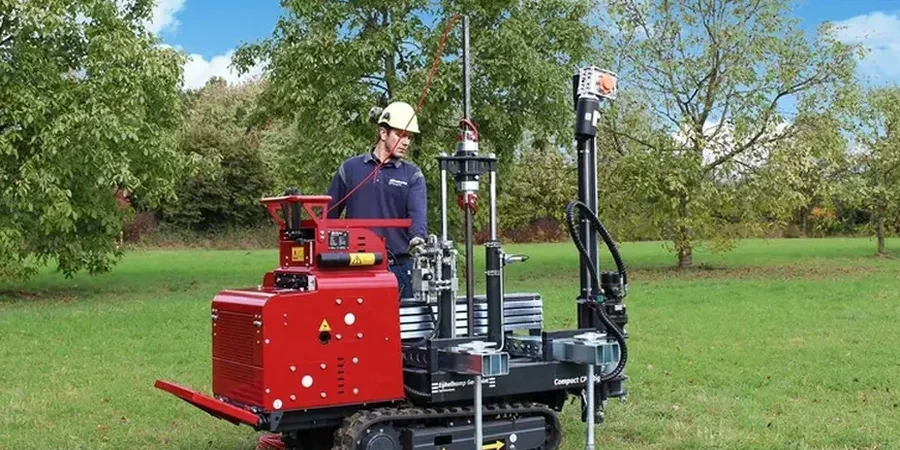
Sunderland’s ground conditions are anything but uniform. With a population exceeding 275,000 and a topography that drops sharply from the Tunstall Hills down to the Wear riverbanks, the subsurface often contains hidden sequences of dense glacial till, pockets of soft alluvium, and reworked mining fill. Foundation engineers working on projects from the Vaux site to residential developments in Washington need more than just isolated borehole data; they require a continuous record of how the soil behaves with depth. The CPT test delivers precisely that. By pushing an instrumented cone into the ground at a constant rate, we obtain real-time measurements of tip resistance, sleeve friction, and pore pressure. This allows our team to identify thin weak layers that standard SPT intervals would miss entirely, a critical advantage when designing deep foundations or assessing liquefaction potential in the Wear lowlands.
In Sunderland's post-industrial landscape, a single continuous CPT profile often reveals more about bearing capacity than three separate SPT boreholes.
Regional considerations
We recently consulted on a project near the Queen Alexandra Bridge where initial SI suggested competent ground, yet differential settlement appeared within months of backfilling. A subsequent CPT profile told the real story: a discontinuous lens of organic silt, barely 300 mm thick, had gone undetected between standard SPT intervals. This is a classic Sunderland scenario, where buried channels of the River Wear have left behind erratic soft deposits trapped within the denser Devensian till. Underestimating these inclusions leads to costly underpinning or, worse, structural distress in brick-clad mid-rise buildings. The cone test detects such layers instantly through a sharp drop in tip resistance and a corresponding spike in pore pressure. In areas with a history of limestone mining or undocumented infill, we also use CPT-derived soil behaviour type charts to map zones of potential collapse before a single pile is driven.
Quick answers
What is the typical cost of a CPT test in Sunderland?
For site investigations in the Sunderland area, the cost for CPT testing typically ranges from £130 to £220 per metre, depending on the total depth of the programme and the complexity of access. Mobilisation costs are calculated separately based on the site's proximity to our base and the specific rig configuration required to penetrate the local dense glacial till.
How does a CPT test compare to a traditional SPT borehole for our Wearside site?
While a borehole with SPT provides discrete samples at 1.5-metre intervals, the CPT gives a virtually continuous vertical profile of resistance. In Sunderland's ground, where thin lenses of soft alluvium or loose sand can exist within dense till, the CPT's greater resolution is often the only reliable way to detect these problematic layers. It also removes the human error associated with SPT hammer energy, producing more repeatable results for geotechnical software modelling.
Can the CPT rig access restricted sites, such as basements or back gardens?
Yes. For projects with limited access, such as terraced streets in Roker or compact commercial units in the city centre, we deploy smaller tracked CPT rigs that can pass through a standard doorway. These units still generate sufficient thrust to reach depths of 15 to 20 metres in typical Sunderland soils, ensuring you get the data you need without requiring extensive demolition or temporary works.