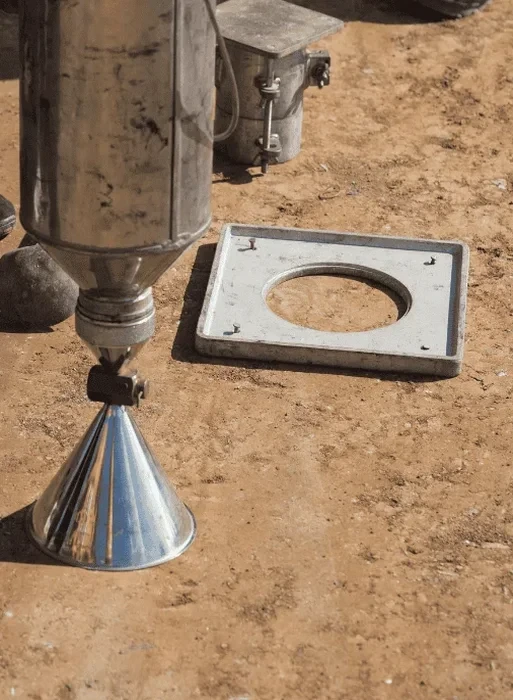
One of the most common callbacks we see in Sunderland starts with a failed air test on a new sewer connection or premature settlement in a car park subbase. The contractor swears the roller made the right number of passes. The material certificate looks fine. But nobody verified density in the ground. Sunderland’s glacial till, particularly the reddish-brown boulder clay that blankets much of the city from Pennywell to Ryhope, changes character over short distances. What compacts beautifully on a Tuesday morning near the Wear can turn spongy after a night of drizzle on the same site. A field density test using the sand cone method—run to BS 1377-9—gives you a direct, defensible number for in-place dry density and moisture content. No assumptions. No lab-to-field extrapolation. Just a measured result that tells you whether the lift actually meets the 95% relative compaction your design calls for. We run these tests daily on Sunderland projects ranging from industrial unit slabs in Castletown to school playing field drainage trenches in Ashbrooke.
Compaction without verification is just hope. A sand cone test gives you a density number you can defend to the adopting authority.
Regional considerations
A warehouse extension in Southwick started showing differential movement within six months of handover. The cause was traced back to a single lift of engineered fill placed during a wet week without any field density verification. The material compacted to roughly 88% of maximum dry density—well below the 95% threshold—and post-construction consolidation did the rest. Sunderland’s glacial till matrix, with its mix of stiff clay and occasional sand lenses, can hold unexpected moisture pockets that standard visual inspection misses. When those lifts get buried under floor slabs or bitumen, the settlement is locked in. A field density test costs a fraction of what it takes to break out a slab, re-excavate, and re-compact. More importantly, it provides the documentation chain that insurers and warranty providers increasingly demand. On public realm projects in Sunderland city centre, where pavement bases must meet strict adoptable standards, we specify sand cone tests at every critical lift to close out the Section 38 or 278 agreement with confidence.
Quick answers
How much does a field density test cost in Sunderland?
A single sand cone density test typically ranges from £70 to £110, depending on site location within the city, number of tests scheduled, and whether it is a standalone visit or part of a larger earthworks QA programme. Mobilisation costs reduce significantly when we batch multiple tests on the same day.
What is the difference between the sand cone method and a nuclear density gauge?
The sand cone method directly measures soil density by excavating a small hole, weighing the removed soil, and backfilling the hole with calibrated sand. It is a destructive, single-point test. Nuclear gauges use gamma radiation to estimate density indirectly and are faster, but they require operator licensing, regular calibration, and compliance with radiation safety regulations. In Sunderland’s mixed glacial soils, we prefer the sand cone method because it avoids the moisture and composition interference that can skew nuclear readings.
How many tests do I need for my earthworks project?
Frequency depends on the specification. For general engineered fill to Series 600 of the MCHW, one test per 500 m² per compacted lift is typical. Road subbase to Series 800 often requires one test per 250 m². Utility trench reinstatement may call for a test every 300 mm of fill depth. We review your project specification during the quoting stage and recommend a testing schedule that satisfies the adopting authority without overspending.