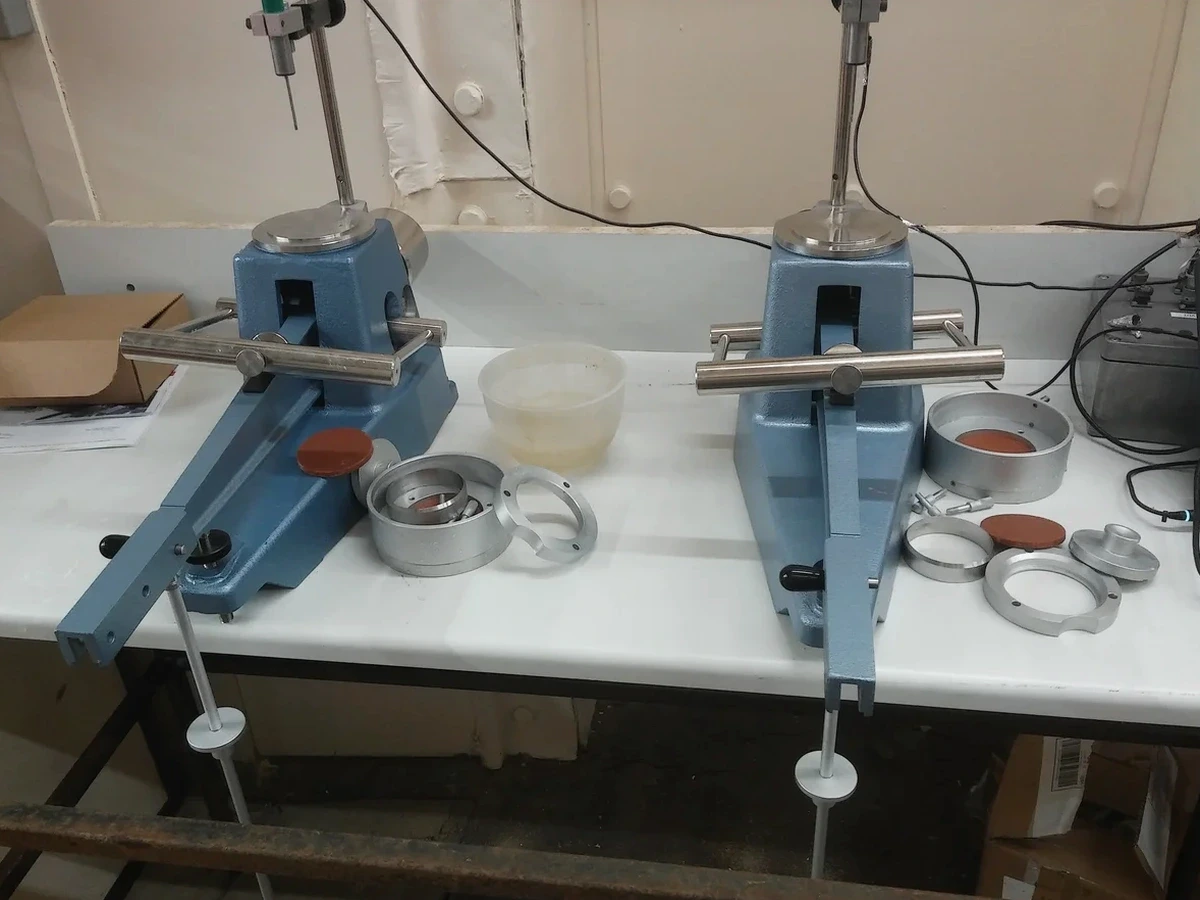
Sunderland’s glacial till and the laminated clays of the Wear lowlands present a specific challenge: plasticity can shift dramatically within a single borehole. We see it often—a stiff brown clay under the limestone gravel transitions into a soft grey silty clay with completely different behaviour. Getting the liquid limit and plastic limit wrong here isn’t just a paperwork error. It feeds directly into bearing capacity assumptions and settlement predictions. Our lab runs the Casagrande method and the fall cone as a cross-check, per BS 5930, because the local Devensian till doesn’t always respond predictably to a single approach. For deeper strata, we pair this data with CPT testing to correlate tip resistance with consistency index, and with triaxial shear to confirm effective stress parameters—both essential when the Wear river alluvium shows borderline classification.
Plasticity data from Sunderland’s glacial till can vary 15% in liquid limit across a 2-metre depth. Single-point testing is a liability.
Regional considerations
East of the A19, near the docks, the made ground overlies organic silts with natural moisture contents above the liquid limit. That’s a liquefaction-prone profile in its own right. In the west, towards Washington, the reworked boulder clay drains better but swells when re-wetted—a seasonal cycle that tears apart lightly loaded footings. Ignoring the Atterberg classification on these sites means overestimating undrained shear strength. The standard plasticity chart from BS 5930 places Sunderland’s tills predominantly in the intermediate to high plasticity zone (CI-MI to CH). Assigning a generic ‘firm clay’ parameter set without verifying the actual PI is a gamble. We’ve seen laboratory PI values of 35% on samples described in the field as ‘sandy clay’. That’s not a minor discrepancy—it changes the allowable bearing pressure by a factor of two. The Sunderland City Council building control increasingly requests classification testing for brownfield sites, particularly where former heavy industry has left variable fill.
Quick answers
How much does Atterberg limits testing cost in Sunderland?
Standard liquid and plastic limit determination ranges from £50 to £80 per sample, depending on whether the fall cone cross-check is included. Volume pricing applies for projects with five or more samples.
Which standard do you follow for Atterberg limits?
We test to BS EN ISO 17892-12:2018, which covers both the Casagrande cup and fall cone methods. Our reporting framework follows BS EN 1997-2 Section 5.4 for classification and derived parameter selection.
How many moisture points do you run for the liquid limit?
A minimum of four points spanning the 15 to 35 blow range for the Casagrande method. For the fall cone, we measure penetration at four moisture contents to establish the linear regression. We do not accept single-point determinations unless specified by a tier-one contractor with a validated correlation for the specific stratum.
Can you test samples from Sunderland’s magnesian limestone clays?
Yes. We air-dry these samples below 50°C to prevent mineral alteration. The high calcium content of the magnesian limestone residue can produce misleading plasticity readings if overdried, so we maintain strict temperature control throughout preparation.